
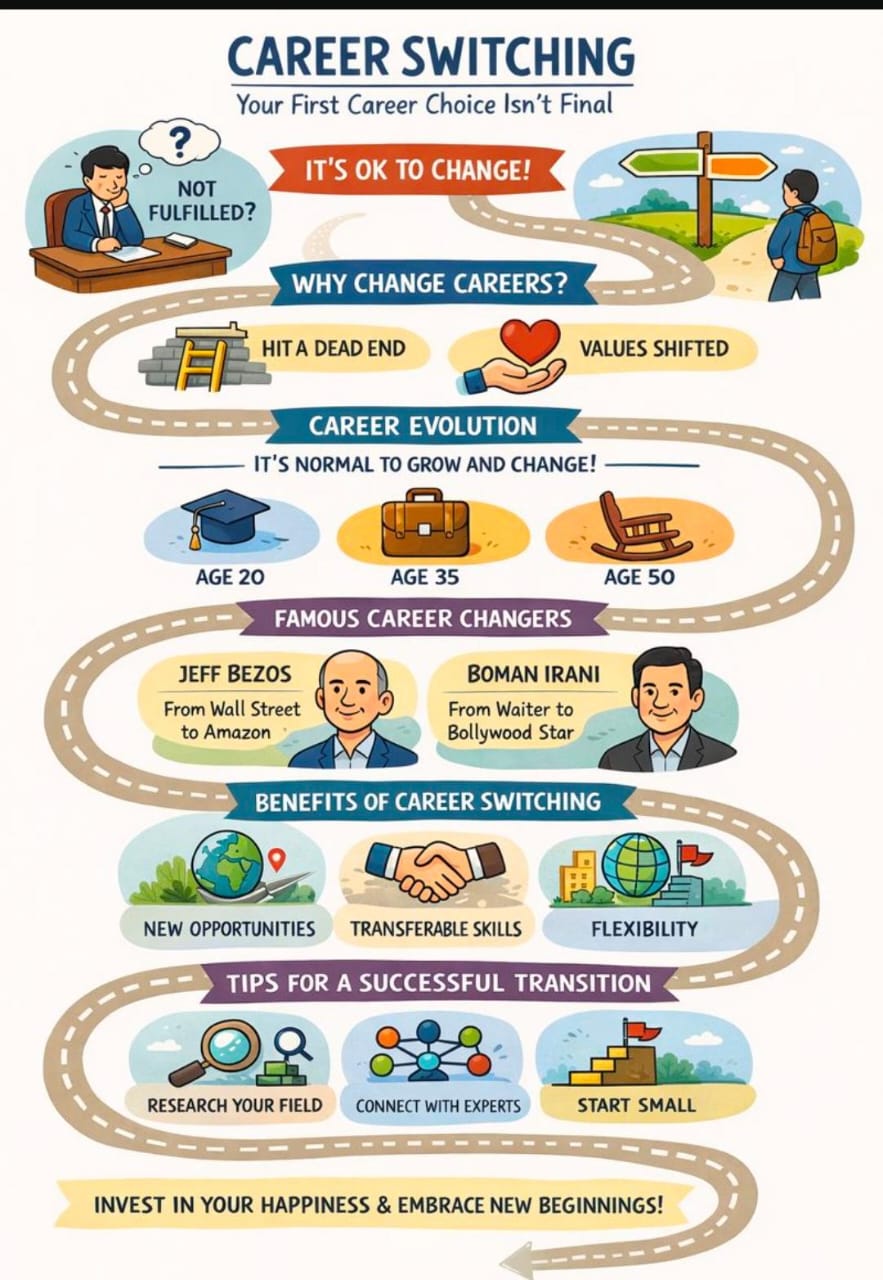
Have you ever felt uncertain about your career, even though it once seemed perfect? If so, you are not failing—you are growing. It is a common misconception that our first job is a lifelong commitment. Contrarily, in reality, a career can never be a fixed point; it is a process. In fact, the ‘dream career’ we choose at twenty is a feeble reflection of who we become by thirty or forty. That moment when the so-called ‘dream job’ no longer feels fulfilling can be unsettling. However, this realisation, most of the time, can form the first step towards living a more authentic life.
Switching paths is not a sign of uncertainty; it is rather a sign of bravery. There could be more reasons for making a change than the number of people who have the courage to do it.These reasons can range from hitting a ceiling that feels more like a dead end to realising that your values have shifted from ‘dominating the corporate world’ to ‘serving the government effectively’. Changing careers is not a crisis—it is a chance for growth.
There may be numerous individuals who are confused about their careers. It is not unusual to come across people who say, "I always wanted to be a doctor" or "I've been dreaming of being a firefighter since I was a child" and wonder, "Why don't I know what I want to do?"
It is a myth that we that everyone should form a clear idea about what career one wants to pursue in life. The concept is often overrated. The crude reason lies in the fact that we are individuals who constantly changing. Our interests, ambitions, goals and skills evolve over time. A career that excited us at eighteen may feel overwhelming at thirty-five and a job that interested us at thirty-five might seem dull by fifty-five. Such a thing is not only normal but also expected.
While the idea of changing careers might seem challenging, think of the freedom it brings.
You can explore new paths, take on roles in unfamiliar industries, try the public and private sectors and work for large corporations or family-run businesses. You can pursue what truly interests you. Success may not be certain in these fields and that is completely acceptable. This will be the perfect opportunity to move on to something else. The job market is designed to support career transitions.
Let us not forget Jeff Bezos who left a secure job on Wall Street at thirty-one to start Amazon. One could also think about Boman Irani who spent fourteen years working in room service and managing a chip shop in Mumbai. He did not switch to photography until he was 32. He did not stop there. He followed his curiosity into theatre and it was not until he was 44—an age when many are planning for retirement—that he made his big Bollywood debut in Munna Bhai M.B.B.S. Boman did not squander two decades selling chips; he was gaining the life experience that made him the versatile actor we admire today. His story shows that you can spend years in one area and still have the courage to enter a completely different field.
The key to a successful career change is creating a path between where you are and where you want to go. Think about how your current skills can be applied in a different setting, rather than just leaving your past behind. You can reduce the risks of change by learning about the new field, connecting with experts and achieving small successes. Remember, you're starting with experience, not from scratch.
Pivoting can be scary and growth can be messy. It is, however, far worse to stay in a life that does not fit. You are choosing a new beginning instead of ending when you embrace being a beginner again.
In the end, changing careers is an investment in your happiness. Your future self—the one who genuinely looks forward to Monday mornings—will thank you for it!
Laavya Lohia
Class XI-C1