
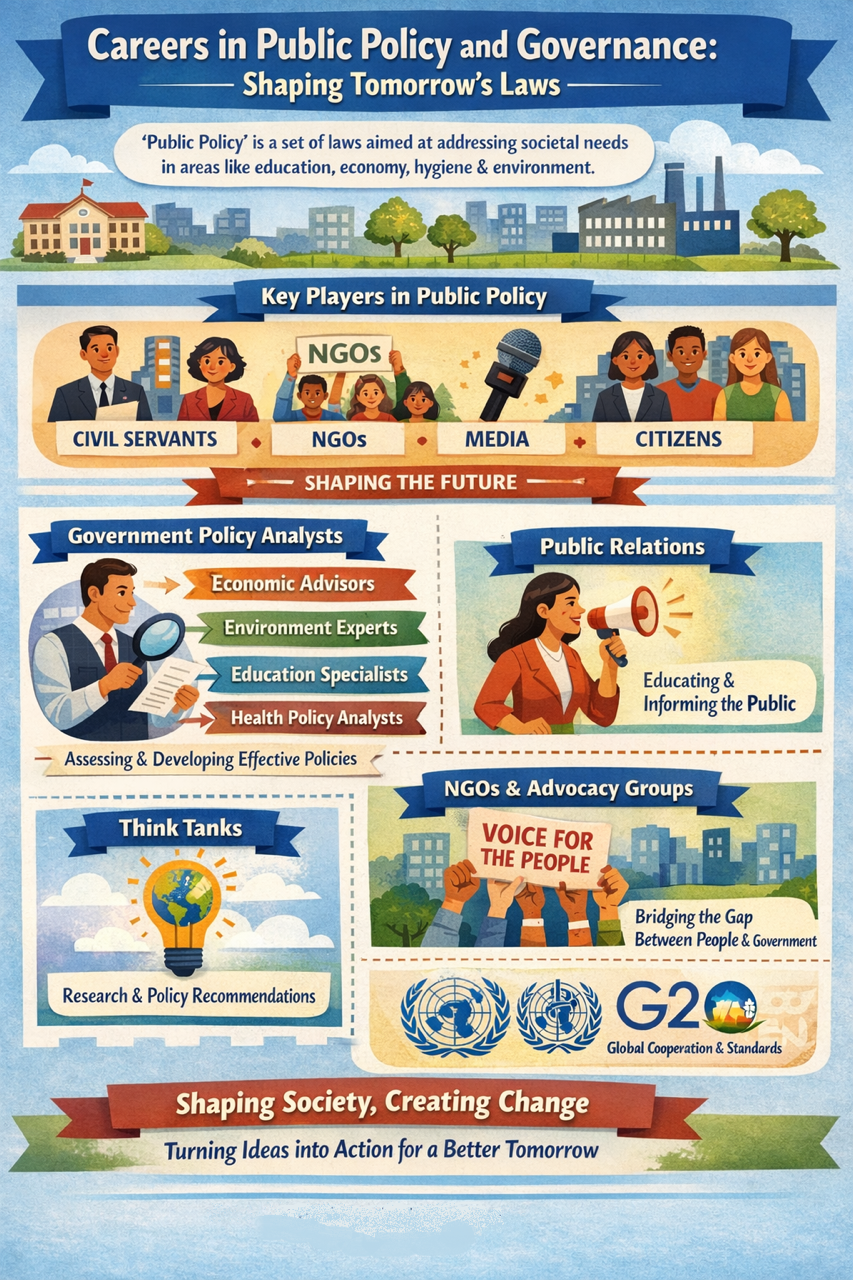
The term ‘Public Policy’ defines itself as a set of laws placed by the government which recognises and addresses urgent societal needs. It aims to reform an environment using socio-economic measures in areas such as education, hygiene, food, economy and environment. A few pivotal examples are ‘MGNREGA’ for employment, ‘Beti Bachao Beti Padhao’ to boost the education for young women and ‘Swachh Bharat Abhiyan’ for sanitation.
It is not just the government who contours public policies. The actors behind public policies, to state a few examples, are civil servants, policy analysts, researchers, NGOs, the media, activists and most importantly, the citizens. No one is exempt from the right to change the country for the better in the eyes of the masses.
There are some vital careers who place themselves in the forefront of shaping public policies. In the government, Policy Analysts work to analyse the impact of laws in practice. They are pivotal points of reference used to ensure practicality of laws. They work to assess societal challenges and make proper solutions. Analysts study political science, economics, law and sociology, which are necessary for analysing society with an impersonal view.
Some subsections of this vast role include economic policy advisors who analyse budgets and fiscal policies, environment policy experts who work on climate change and sustainability laws, education policy specialists who improve curriculums and access to education and health policy analysts who study healthcare systems and public health laws.
Public relations workers work to educate people about policies and convey messages sent by the officials in charge to the public. They aim to establish confidence in the public about the governance and its laws. They spread information through interviews in the news, social media and visit remote areas personally to hold conferences to spread their policies to everyone.They tend to study communication relations, strategic planning and crisis management.
Non-Governmental Organisations (NGOs) work as advocates for the people to implement policies. They note the needs of vulnerable groups. They bridge gaps between the government and the people, making sure to allow individual voices to be heard. They use measures such as PILs to advocate for reform. However, they are unable to ensure the making of policies but work for the needs of the people.
Think Tanks influence governments by conducting research for the needs of the people. They are similar to NGOs in that they advocate for changes in the system to shape public opinion through media and personal research. NITI Aayog is a premier policy think tank of the Government of India.
International organisations work with bigger bodies like the WHO, the UN and the World Bank. They set norms, provide funds for and coordinate actions for health, trade, security and the environment. The G20 is a system by the UN used to advocate for the environment. This is used to voice the unheard voices of the masses into one precise public opinion.
These roles are not just professions. They are opportunities to shape the future. Every policy that is designed or those that have been successful through NGOs and think tanks have reformed societies for the better. This field offers those who want to impact society positively a chance to do so by turning ideas into a lasting change.
Asmi Banerjee
Class XI-H