The originality of the human brain and innovation is often disrupted when it hears the word ‘traditional’. As tedious as the word is in general, when paired with education or degrees, it tends to produce what feels like the most monotonous combination imaginable. Bringing limelight to traditional degrees, these programmes follow a conventional approach of conducting education, fastening on standard modes of learning through handbooks, lectures and examinations. The kind of education is generally concentrated on in-depth knowledge of the theoretical aspects of the subject with veritably little focus on the practical aspects. The programmes are designed keeping theoretical knowledge in mind and are offered by regular institutions and universities. It sounds as though it could be someone’s worst agony.
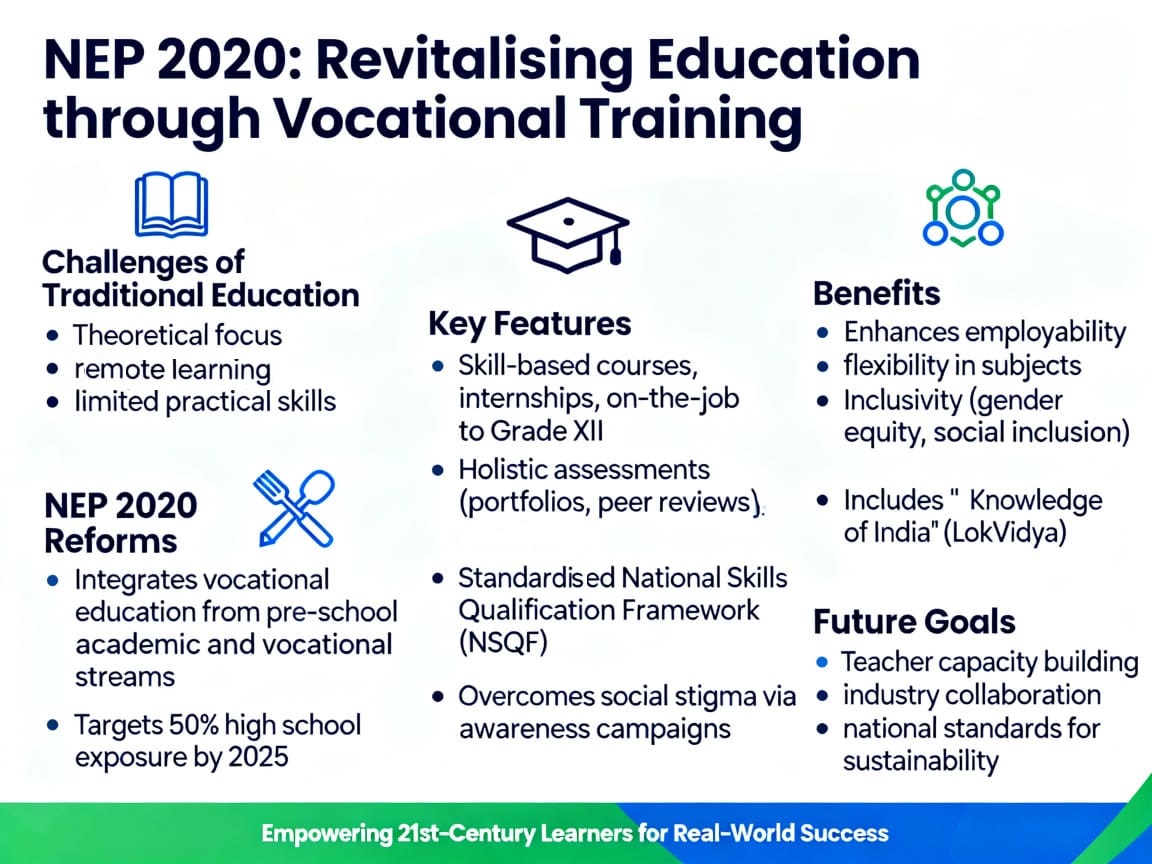
In this day and age, with one’s exposure to innumerable ideas across the internet, creativity is a strong faculty that most people not only possess but nurture as well. There is hardly anyone who wishes to slog through big handbooks anymore. They prefer learning that is concise, applicable and intellectually stimulating. They look for learning that feels meaningful, not mechanical. Thus, National Education Policy 2020 has been able to address this orthodox pattern, reimagined the idea of traditional degrees and replaced it with vocational training. National Education Policy 2020 proposes the modification and reconstruction of all aspects of education, including the educational structure, regulations and governance, to produce a new system which is aligned with the aspirational claims of 21st century scholars. This policy aims to overcome the social stigma behind vocational education by organising mindfulness programmes based on communication and media movements. Skill-grounded exercises have been introduced from the pre-school stage to Grade XII, supported by class reforms that have strengthened vocational knowledge and aligned courses with skill principles. Workroom skills have been developed through externships and on- the- job training while aptitude and internal assessments have guided informed career choices.
Qualifications have also been standardised through National Occupation norms to meet social and profitable requirements which has been an overall help in the integration of vocational and general education with emphasis on social addition, gender equivalency and inclusive literacy. Developing and implementing a holistic assessment and evaluation system has been a challenge which has been addressed by conducting interest and aptitude tests and using multiple tools such as group work, portfolios, presentations and peer assessment to ensure a 360-degree evaluation of learning outcomes. NEP has also taken into account the ‘knowledge of India’ and has made LokVidya an important vocational knowledge which includes understanding of ancient India and its contributions to modern India and its successes and challenges and a clear sense of India’s future aspirations with regard to education, health and environment. Vocational education allows increased flexibility in the choice of subjects and also includes vocational subject so there are no limitations.
In conclusion, it is quite reassuring that NEP 2020 has emphasised vocational education and skill training along with capacity building of teachers to enhance employability and practical skill development of learners at all levels. To elevate quality and ensure sustainability, the introduction of standardised courses, national skill standards and organised registration of training providers is planned. The policy underlines the need for efficient administration, effective governance and strong support systems at the national, state, district and institutional levels. It also focuses on recognising and sharing best practices in vocational education and training, so that ideas that work well in one institution can be adopted by others. This helps improve teaching methods and makes implementation more effective overall.
Siddhiksha Majumdar
Class - XI C1