
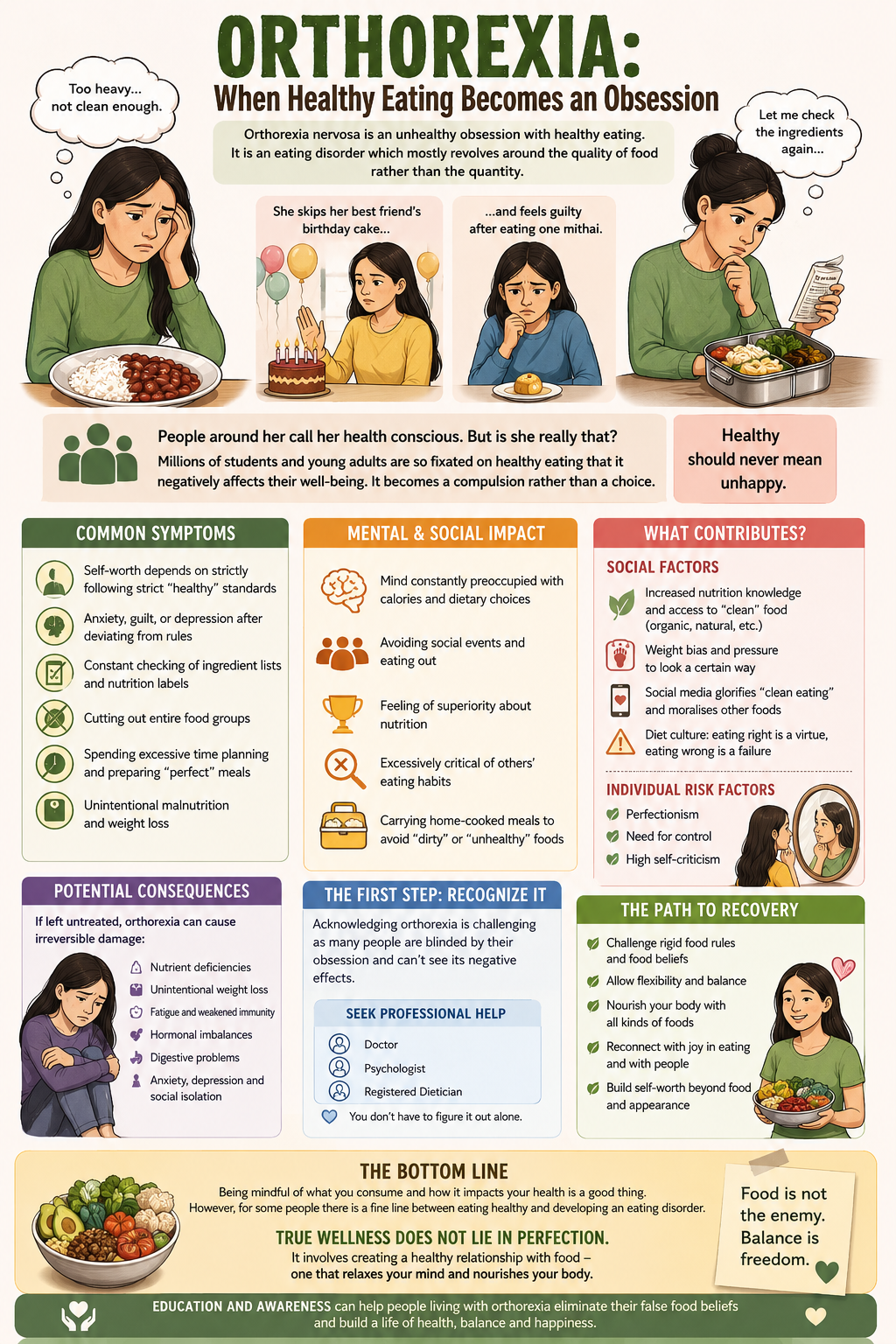
Imagine a student who refuses to eat rajma chawal made by her mother, skips her best friend's birthday cake, ponders over the ingredients in her tiffin and feels guilty after eating one mithai. People around her call her health-conscious… but is she really that? Millions of students and young adults like her are so fixated on healthy eating that it negatively affects their well-being. It becomes a compulsion rather than a choice.
Orthorexia nervosa is an unhealthy obsession with healthy eating. It is an eating disorder that primarily revolves around the quality of food rather than its quantity. Unlike anorexia or bulimia, people with orthorexia focus on the cleanliness or purity of their food instead of the urge to lose weight or become thin.
In the present scenario, orthorexia does not have an official diagnosis but it does have some common symptoms. People with orthorexia feel that their self worth depends on their capability to meticulously follow the healthy standards they set for themselves. Any deviation from these self-made standards leads to anxiety and depression. They constantly check ingredient lists and nutrition labels, cutting out large food groups. They spend an unusual amount of time planning and preparing meals they perceive as healthy. Their bodies become devoid of essential nutrients and they experience unintentional malnutrition and weight loss.
Moreover, they go down into a mental rabbit-hole and their mind is constantly preoccupied with calories and dietary choices, making them socially inactive. They avoid going to social events. They have a feeling of superiority around their nutrition and are excessively critical of the eating habits of other people. Such people often carry home-cooked meals to avoid eating foods which they consider ‘dirty’ or unhealthy.
Social factors such as increased nutrition knowledge, access to clean food like organic products and weight bias are also associated with orthorexia-related behaviours. Further, the rapid promotion of clean-eating lifestyles on social media moralises it by painting other foods as undesirable. The constant pressure to look a certain way also plays an important role. Diet culture tells us that eating right is a virtue and eating wrong is a failure. Individual risk factors include tendencies towards perfectionism and control.
If left untreated, orthorexia can cause irreversible damage to a person’s health. The first step towards overcoming orthorexia is identifying its presence. Acknowledging this problem is challenging as many people who suffer from this disorder are blinded by their obsession and are unable to notice its negative effects on their body and social functioning. It is important to seek medical help from a doctor, psychologist or a registered dietician. Finally, education and awareness may help people living with orthorexia eliminate their false food beliefs.
Being mindful of what you consume and how it impacts your health is a good thing. However, for some people there is a fine line between eating healthy and developing an eating disorder. True wellness does not lie in perfection. It involves creating a healthy relationship with food – one that relaxes your mind and nourishes your body.
Rishika Agarwal
Class XII-C2